
Key takeaways
- • Swing gates cost less and look better; slide gates solve grade and space problems.
- • UL 325 safety devices are legally required, not optional add-ons.
- • The pier is the project — undersized piers cause most gate failures.
- • Battery backup and manual release are essential during hurricane season outages.
Swing, slide, cantilever or something else
Swing: lowest cost, best appearance, needs clear arc and level or downward-sloping approach. A gate that scrapes a rising driveway is the classic error.
Slide (V-track): good for short driveways and grade, but the ground track collects debris and sand, which in South Florida means service calls.
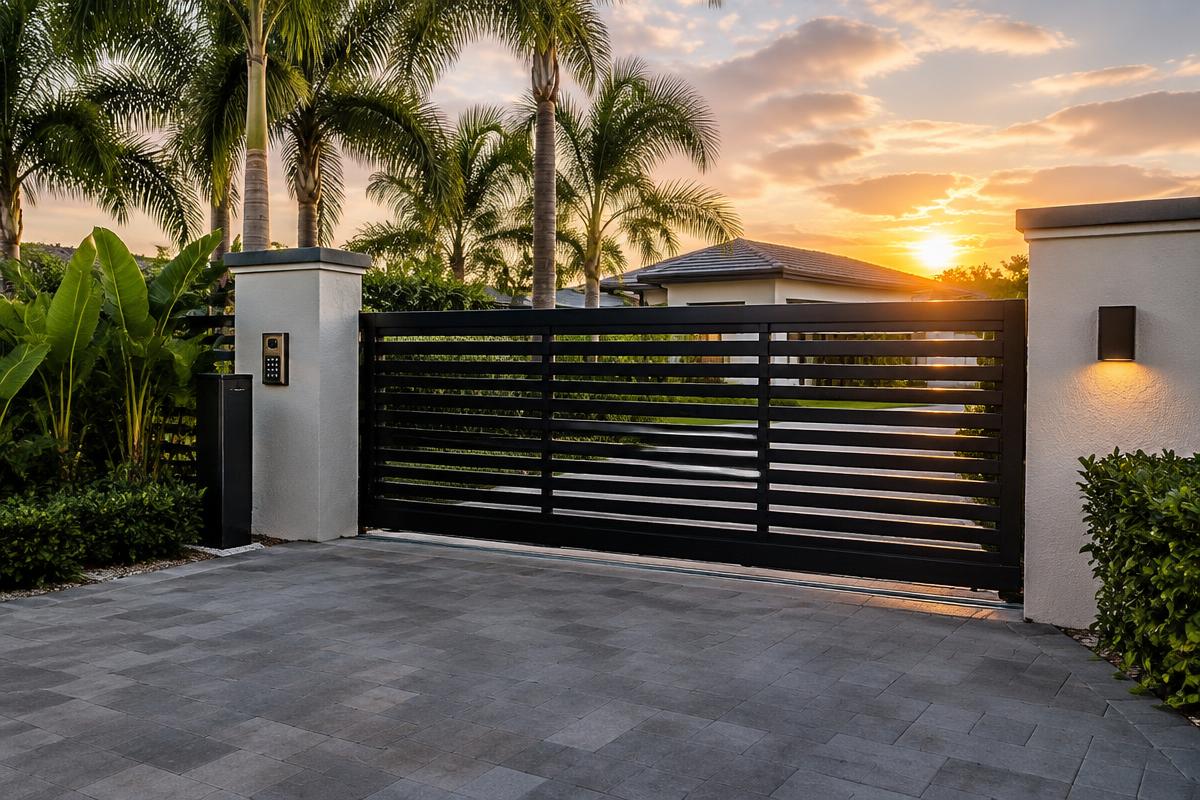
Cantilever: no ground track, spans to 40 feet, ideal for commercial and for residential drives with room along the fence line.
Bi-fold and vertical pivot: for tight urban lots where nothing else fits; more mechanism, higher cost, but they solve otherwise impossible sites.
Sizing the operator and the pier
Operators are rated by gate weight, leaf length and cycles per day. Under-sizing is the most common cost-saving mistake and it shows up as premature gearbox failure around year three.
The pier carries the entire dead load plus the wind load of a partially solid leaf. We pour reinforced piers with rebar cages sized to the gate, stub conduit through them at design stage, and set hinge hardware into the steel rather than surface-mounting it.
Safety and compliance
UL 325 and ASTM F2200 require entrapment protection. That means an inherent reverse in the operator plus at least one external device — photo-eyes or a monitored safety edge — plus guarded pinch points, physical stops, and warning signage on both sides.
- Photo-eyes covering both open and close travel
- Monitored edges on commercial and high-traffic gates
- No exposed rollers or reachable pinch points
- Fire access via Knox box, Click2Enter or strobe preemption per jurisdiction
- Manual release accessible from inside the property
Access control options
Keypad and remotes for a single family. Telephone entry or video intercom when guests and deliveries are frequent. Cellular and app-based control when you want to grant access remotely. License plate recognition and credential logs for commercial yards and gated communities. Time-limited PINs for cleaners, landscapers and delivery drivers are the single most-appreciated feature we install.
What it costs
A single aluminum swing gate with one operator and a keypad, on an existing powered pier, starts around $6,500. A double ornamental gate with new piers, trenching, intercom, loops and full access control commonly lands between $18,000 and $45,000. The variables are span, material, fabrication complexity, pier work and how far power has to travel.
Maintenance that prevents the 3 a.m. call
Twice a year: lubricate hinges and rollers with a marine-grade product, inspect and clean photo-eye lenses, test the manual release, check battery condition, verify loop function and inspect the coating at every weld. Gates that get this service routinely outlast gates that do not by many years.
Questions we get on this topic
How much does an automatic gate cost in South Florida?
Complete systems generally run $6,500 to $45,000 depending on span, material, piers, trenching and access control.
How long do gate operators last?
A correctly sized operator on a maintained gate commonly runs 10 to 15 years in this climate. Undersized operators on heavy gates often fail within three to five.
Can you automate my existing gate?
Often yes, if the gate is structurally sound, hangs true and the piers can carry the operator loads. We assess the hinges, frame and pier before quoting.