
Key takeaways
- • Wood starts from $32 per linear foot in the calculator; not all designs use that rate.
- • Full privacy and shadowbox provide different sightlines.
- • Gates, removal, access and approvals must be defined separately.
- • No solid privacy fence is hurricane-proof.
The starting rate is not the backyard total
Our calculator starts wood fencing from $32 per linear foot. Different heights, board patterns, gates and site work can move the estimate substantially. Use the calculator’s full range rather than multiplying the starting rate and treating it as an offer.
Vinyl, wood and other privacy configurations should be compared on the same length, height and gate layout. Published planning figures do not resolve demolition, excavation, approval costs or product choices at your property.
Choose the sightline you want to block
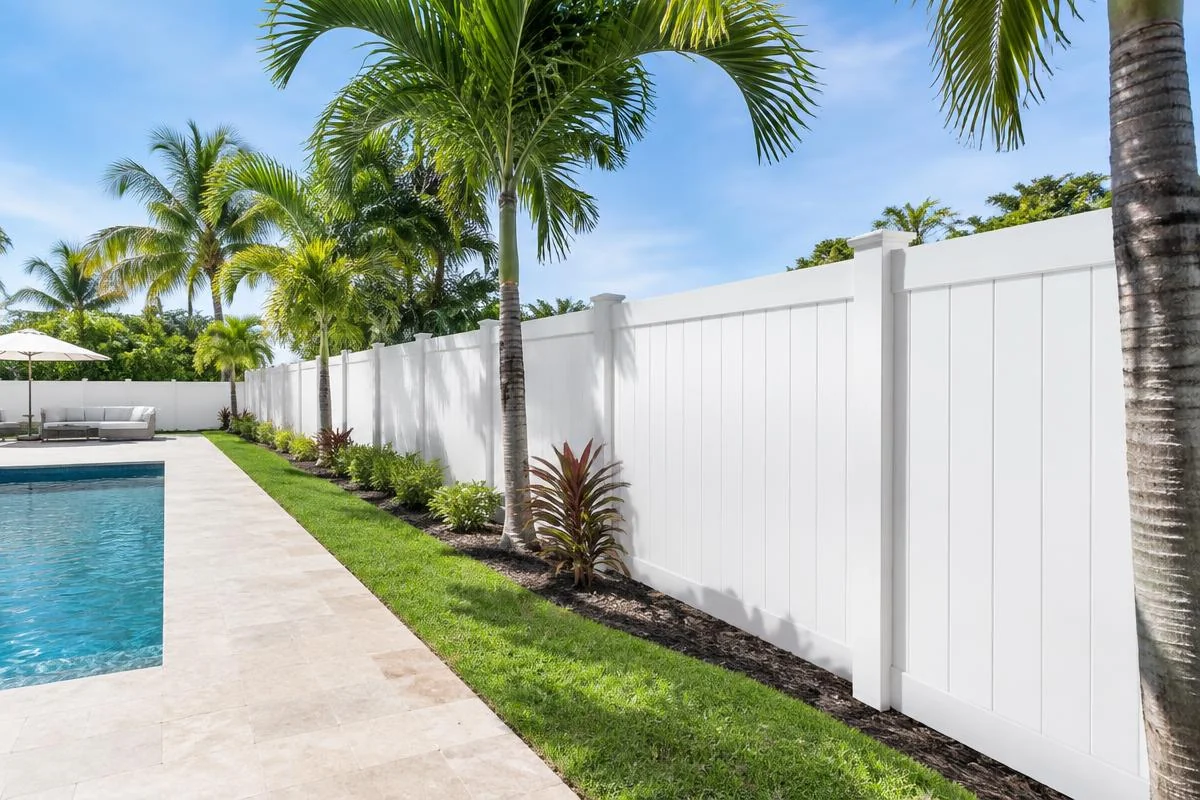
Board-on-board wood overlaps boards to help reduce direct gaps, while shadowbox alternates boards and permits some angled views. Solid vinyl screens direct views; semi-privacy and accent-top styles leave openings. Look from the direction where privacy matters.
Raised patios, neighboring windows and changing grade can affect what a fence screens. A taller panel may not be allowed or necessary. Confirm approved height and layout before pricing the final system.
Wood privacy and vinyl privacy are different ownership choices
Wood offers a natural appearance and individual-board repair, but moisture movement and periodic finishing deserve attention. Vinyl commonly avoids routine painting and staining but still needs cleaning, suitable supports and gate maintenance.
Ask for the actual lumber or panel system and written warranty terms. Do not assume a fixed lifespan or guaranteed long-term savings based only on material. Coastal exposure, impacts and care can change ownership requirements.
Identify gates and removal explicitly
A backyard gate needs usable clearance and hardware suited to its purpose. List pedestrian and equipment openings separately from the fixed runs. Wide or multiple openings can change supporting-post and labor requirements.
Removing old boards or panels is not the same scope as removing posts, footers and all debris. Identify what remains, what is removed and who handles disposal. Ask whether a calculator allowance covers the specific condition you are describing.
Solid panels require a complete installation design
A privacy panel interacts with wind differently from an open picket or mesh fence. The selected panels, posts, connections and supports must suit the configuration and site. A material name or generic footer dimension does not establish that suitability.
Ask for applicable installation and approval details and do not add screening to an existing open fence without review. No fence should be sold as hurricane-proof; this is planning guidance, not a construction design.
Turn the planning range into a written quote
Bring a survey if available, desired material and height, approximate lengths, gate widths and removal details. Confirm jurisdiction and applicable association rules, then ask who prepares the required documents.
The measured proposal should identify quantities, materials, supports, hardware, exclusions and schedule dependencies. Use the calculator to compare scenarios and the written estimate to decide what will actually be installed.
Questions we get on this topic
Does wood always cost $32 per foot?
No. That is the calculator’s starting rate; layout, height, gates and site work change the broad range and final quote.
Does shadowbox give complete privacy?
Not from every angle. Compare the board pattern and sightline with board-on-board or another screening system.
Can a privacy fence be promised to survive every hurricane?
No. Performance depends on the whole system, installation, exposure and impacts. Request project-specific details instead of a guarantee.
Planning references
This guide is general planning information, not an engineering design, legal opinion or substitute for current property-specific requirements and manufacturer instructions.